

A Hands On Guide to Uncore Performance Monitors: Measuring Throughput and Histogram Based Latency

When you need to know how fast data actually moves through PCIe® links, fabrics, or DMA engines, CPU IPC/CPI isn’t the right lens—those are core metrics. Real I/O bandwidth (BW) and latency live in the uncore (I/O controllers, fabrics, memory subsystem). Silicon vendors instrument these blocks with Performance counters that software can read in real time. For example, Intel’s IIO (Integrated I/O) uncore PMU is documented for analyzing PCIe controller traffic from software, while NVIDIA Jetson platforms […]
Key Technologies in Modern VLSI: CMOS, MEMS, and Beyond

The evolution of modern electronics is built on Very Large Scale Integration (VLSI) technologies, which allow millions of transistors and components to be integrated onto a single chip. This integration drives the creation of compact, high-performance, and energy-efficient devices. Traditional technologies like CMOS (Complementary Metal-Oxide-Semiconductor) and MEMS (Micro-Electro-Mechanical Systems) remain crucial, while emerging innovations such […]
Bridging the Gap: From Functional Description to RTL Design, Challenges & Solutions
Converting a functional specification into a Register-Transfer Level (RTL) implementation is a foundational activity in digital hardware engineering. This transformation takes high-level, often untimed intent and turns it into a cycle-accurate, power-aware, and silicon-feasible design. The process introduces timing semantics, concurrency, control, resource constraints, and verification considerations, each of which directly impacts schedule, cost, and […]
Low Power Design Techniques in VLSI: The Secret for Energy-Efficient Chips!
We’ve all been there, your device is running out of battery faster than you can say, “low power mode.” But for a hardware engineer, the real challenge isn’t just making things work. It’s making things work efficiently, using as little energy as possible. This is where Low Power design comes in. It’s crucial practice in […]
Understanding eSPI: The Modern Communication Bridge in Computers
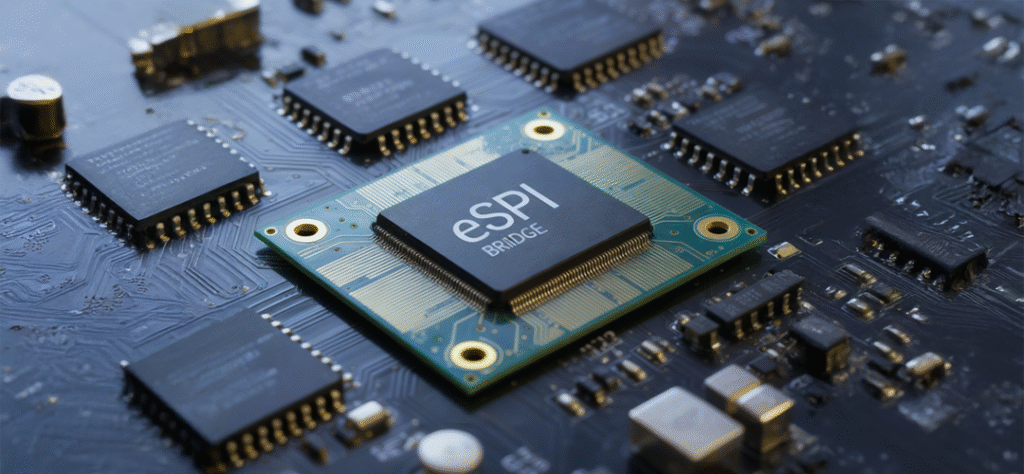
What is eSPI? The Enhanced Serial Peripheral Interface (eSPI) is an Intel-defined communication protocol designed for modern computer motherboards and embedded systems. It acts as a bridge connecting the Platform Controller Hub (PCH)—the system’s main chipset—with various peripheral components such as the Embedded Controller (EC), BIOS flash memory, TPM, and other low-speed devices. Why eSPI […]
Top Verification Bottlenecks in Modern Chip Design (and How to Solve Them)

As the demand for smarter, faster, and more power-efficient chips continues to rise, the complexity of modern integrated circuits (ICs) and system-on-chip (SoC) designs is growing at an exponential pace. This increase in design complexity has brought verification challenges to the forefront. In fact, industry studies suggest that up to 70% of the total chip […]
What is Design-for-Verification (DFV) and Why Does It Matter
In today’s semiconductor industry, the relentless pursuit of building faster, more efficient, and increasingly complex chips is ongoing. From data centers to smartphones to autonomous vehicles, modern applications demand systems-on-chip (SoCs) and ASICs with high performance, low power consumption, and uncompromising reliability. However, as chip complexity increases, so does the challenge of ensuring that the […]
The Complete Guide to VLSI Design Verification
In the fast-paced world of semiconductor innovation, the success of any chip design hinges not just on its creativity but on its accuracy and reliability. With billions of transistors integrated on a single chip, VLSI (Very Large Scale Integration) Design Verification becomes a mission-critical step in ensuring that the intended functionality is delivered before fabrication. […]
Emerging Trends in Semiconductor Design and Verification

The semiconductor industry stands at the forefront of technological innovation, continually pushing boundaries to meet the growing demands for smarter, faster, and more energy-efficient devices. As integrated circuits become increasingly complex, incorporating billions of transistors on a single chip, the challenges of design and verification intensify. To keep pace, engineers and companies must embrace emerging […]
What is Compute Express Link (CXL) ?

What is CXL ? Compute Express Link (CXL) is an open industry standard that provides high-bandwidth, low-latency connections between host processors and devices like accelerators, memory buffers, and smart I/O devices.. The Role of CXL in Enhancing Performance As cloud computing becomes ubiquitous, data centers face an ever-increasing demand for computing capacity and faster processing […]